What Is Marble Wall Cladding?
Marble wall cladding refers to the application of thin marble slabs, tiles, or panels onto vertical wall surfaces — interior or exterior — to create a protective, decorative finish. Unlike solid marble construction, cladding uses relatively thin cuts of stone (typically 10 mm to 30 mm thick) bonded or mechanically fixed to a substrate wall. This approach delivers the visual richness and tactile quality of natural marble at a fraction of the weight and cost of full stone construction, making it accessible for residential feature walls, commercial lobbies, hospitality environments, and high-end retail spaces.
Marble is a metamorphic rock formed when limestone is subjected to intense heat and pressure over geological timescales. The recrystallization process produces the mineral interlocking structure that gives marble its characteristic translucency and the distinctive veining patterns caused by mineral impurities — iron oxides for gold and rust tones, graphite for grey and black streaks, and serpentine for green hues. No two marble slabs are identical, which means every cladding installation is inherently unique — a quality that no manufactured material can fully replicate.
Main Types of Marble Used for Wall Cladding
The global marble market offers hundreds of named varieties, but a core selection of stone types accounts for the majority of wall cladding applications. Understanding the properties of each helps designers and specifiers match stone character to spatial requirements.
Carrara Marble
Quarried in the Apuan Alps of Tuscany, Italy, Carrara is the most widely used white marble in the world. It features a white to blue-grey background with soft, feathery grey veining. Its relatively consistent patterning makes it easier to book-match across large wall installations compared to more dramatically veined varieties. Carrara is commercially available in multiple grades — CD grade for cost-sensitive commercial projects and higher-grade "statuario" quality for premium residential or hospitality applications.
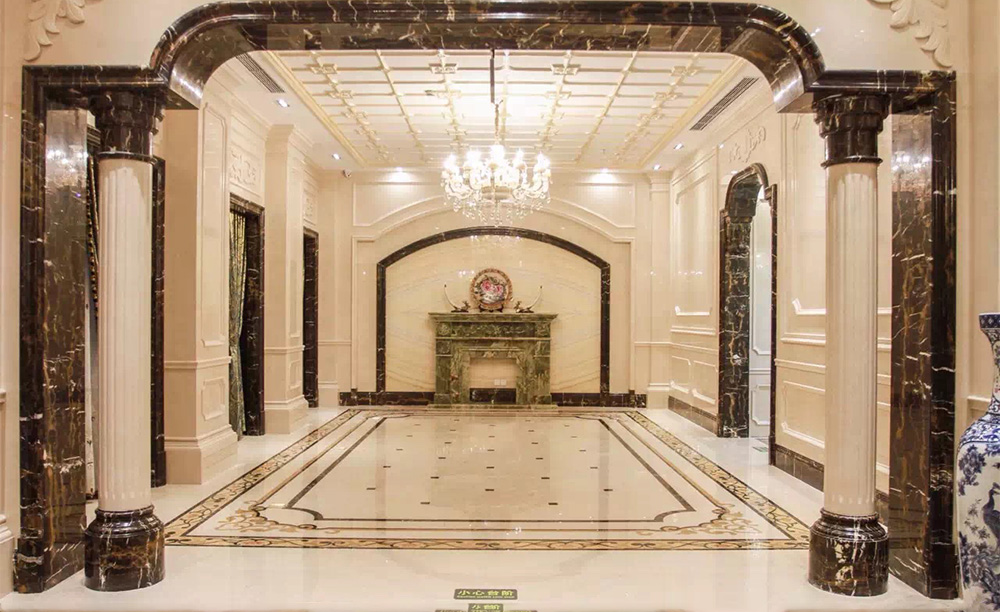
Calacatta Marble
Also from the Carrara region but quarried at higher elevations, Calacatta marble is distinguished from Carrara by its brighter white background and bolder, more dramatic veining in gold and thick grey tones. It is considerably rarer and more expensive than standard Carrara. Calacatta is the preferred choice for statement feature walls, luxury bathroom surrounds, and fireplace cladding where visual impact is the primary design objective.
Emperador Marble
Sourced primarily from Spain, Emperador marble ranges from a rich dark chocolate brown (Emperador Dark) to a warm tan-brown (Emperador Light), with white and beige veining running through the stone. It offers a warm, masculine character well suited to feature walls in studies, hotel bars, restaurant interiors, and retail environments seeking a rich, grounded aesthetic rather than the cooler brightness of white marbles.
Nero Marquina Marble
This intensely black marble with crisp white veining originates from the Basque Country of Spain. Nero Marquina creates high-contrast, dramatic wall cladding in contemporary and minimalist interiors. It is frequently used as an accent wall behind reception desks, in powder rooms, and in commercial bar or restaurant environments where a bold visual statement is desired. Because of its dark background, it shows dust and watermarks more readily than lighter marbles and requires more frequent maintenance in public spaces.
Travertine
Technically a form of limestone rather than true metamorphic marble, travertine is grouped with marble cladding materials in most design and trade contexts. Its characteristic porous surface — filled or unfilled depending on the finish specification — gives it a warm, textural quality distinct from the smooth crystalline surface of true marble. Travertine in cream, ivory, walnut, and silver variants is widely used for both interior and exterior wall cladding, particularly in Mediterranean-influenced architecture and resort environments.
Surface Finishes and Their Effect on Wall Cladding
The surface finish applied to marble cladding panels significantly alters both the visual character and the practical performance of the installation. Specifying the correct finish for each application is as important as choosing the right stone variety.
| Finish |
Appearance |
Best Application |
| Polished |
High gloss, deep color, reflective |
Lobbies, feature walls, bathrooms |
| Honed |
Matte, smooth, understated |
Residential walls, spa environments |
| Brushed |
Soft sheen, aged texture |
Rustic, transitional, and boutique hotel interiors |
| Leathered |
Textured, low-gloss, tactile |
Feature walls, dark marble accent panels |
| Split-face / Stacked |
Rough, three-dimensional, natural cleft |
Exterior facades, landscape walls, feature columns |
Where to Use Marble Wall Cladding: Interior Applications
Marble wall cladding performs across a wide range of interior environments. Each application context places different demands on the stone in terms of moisture resistance, impact tolerance, pattern continuity, and maintenance access.
- Bathroom and wet room walls: Marble's impermeability (when properly sealed) and its association with luxury bathing culture make it the premium choice for shower enclosures, bath surrounds, and basin splashbacks. Honed finishes are preferred here to reduce the visibility of water spotting on polished surfaces.
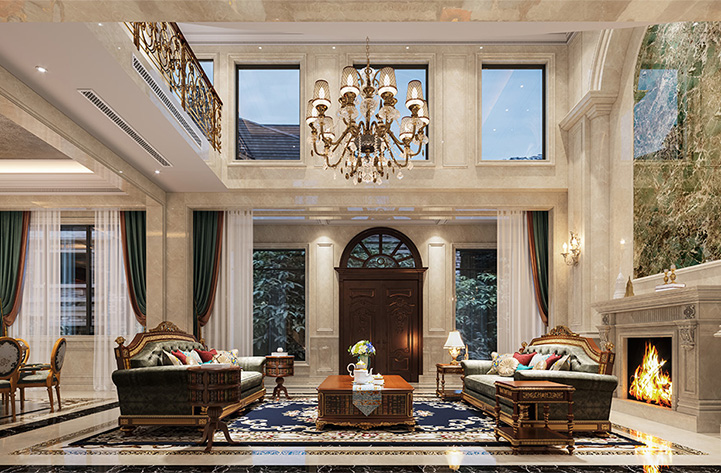
- Living room feature walls: A floor-to-ceiling marble cladding panel behind a sofa or fireplace creates an immediate focal point. Calacatta or bookmatched Statuario slabs with continuous veining are particularly effective in open-plan living spaces with generous ceiling heights.
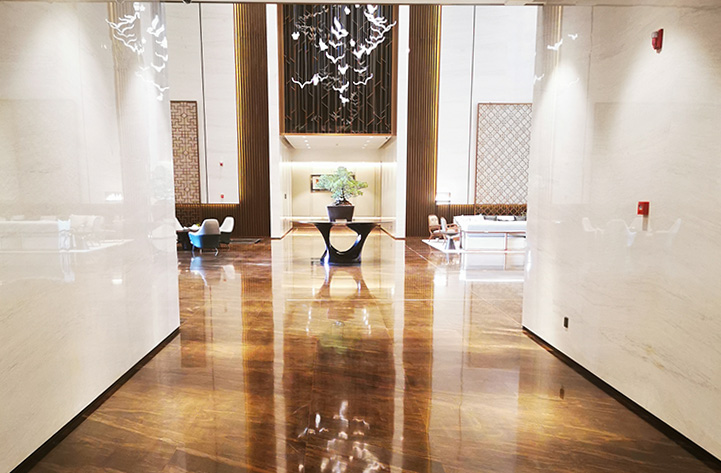
- Hotel lobbies and reception areas: Polished marble wall cladding signals quality and permanence in commercial hospitality environments. Large-format slabs with minimal grout joints are the preferred specification for premium hotel projects.
- Kitchen splashbacks: Marble splashbacks behind hobs and countertops add warmth and character to kitchen designs. Because marble is susceptible to etching from acidic foods and cleaning products, honed finishes are preferable in kitchens since etching is less visible on matte surfaces.
- Fireplace surrounds and chimney breasts: Marble has been used for fireplace cladding since classical antiquity. The material's heat tolerance (when installed with correct adhesives and grout) and its visual weight make it ideal for framing a fireplace opening in both traditional and contemporary interiors.
Exterior Marble Wall Cladding: What You Need to Know
Marble is used on exterior facades in many of the world's most celebrated buildings, from the Taj Mahal to modern commercial towers. However, exterior marble cladding requires more careful engineering than interior installation. Freeze-thaw cycles cause moisture trapped in stone pores to expand, which over time can induce surface spalling or delamination. Acid rain attacks polished marble surfaces, dissolving calcium carbonate and progressively dulling the finish — a process clearly visible on many historic European marble monuments.
For exterior applications, denser, lower-porosity marble varieties should be specified, and mechanical fixing systems (rather than purely adhesive bonding) are required to ensure panels remain securely anchored as the underlying structure moves thermally. A rear-ventilated facade system — where marble panels are fixed to a secondary steel or aluminum sub-frame with a ventilated cavity behind — is the preferred approach for high-rise or large-area exterior marble cladding, as it allows moisture to escape and prevents the hydrostatic pressure buildup that causes adhesive bond failure.
Design Ideas: Getting the Most from Marble Wall Cladding
Book-Matching for Symmetrical Drama
Book-matching involves cutting consecutive slabs from the same block and opening them like the pages of a book, so the veining mirrors symmetrically across the joint. This technique transforms natural stone variation from a challenge into a design asset, creating butterfly-wing or cathedral-arch vein patterns across large wall installations. It requires careful selection and quarry sequencing and adds cost, but the visual result is unachievable with any other material.
Mixed Stone Inlay and Banding
Combining marble with contrasting stone inserts — such as a white Carrara field with Nero Marquina border banding, or an Emperador background with brass inlay channels — adds geometric precision to an organic material. This approach references classical Roman and Byzantine mosaic and opus sectile traditions while remaining thoroughly contemporary in minimalist or Art Deco-influenced interiors.
Thin Marble Panels with Backlit Illumination
Marble slabs cut to 10–15 mm thickness allow light to transmit through the stone, revealing the internal crystal structure and veining with extraordinary luminosity. When bonded to a glass or acrylic backing panel and lit from behind with LED strip lights, these translucent marble panels create a glowing wall surface that completely transforms at night. This technique is particularly effective with white and honey-toned onyx or Calacatta marble in spa reception areas, bar back-walls, and luxury residential media rooms.
Installation, Sealing, and Long-Term Maintenance
Successful marble wall cladding installation begins with substrate preparation. The backing wall must be structurally sound, flat to within 3 mm over a 2-metre span, and free from moisture ingress, movement, or vibration. Large-format marble panels (slabs over 600 × 600 mm) require epoxy-based or polymer-modified tile adhesives applied with full back-buttering to eliminate voids that could cause future cracking under load. Grout joint width should be specified to accommodate thermal movement — typically a minimum of 2 mm for interior installations and 5 mm or more for exterior applications subject to solar gain.
Sealing is non-negotiable for marble in any location where water, oil, or food contact is possible. A penetrating impregnator sealer — applied to the cleaned, dry stone surface before grouting and reapplied annually in high-use areas — blocks the pore structure without altering the surface appearance. Routine cleaning should use only pH-neutral stone cleaners; acidic products such as vinegar, lemon juice, or general bathroom cleaners will etch the calcite matrix and cause permanent surface dullness that requires professional honing to restore. With correct specification, installation, and maintenance, marble wall cladding will retain its beauty and structural integrity for decades, making it one of the most durable and value-sustaining wall finish choices available.